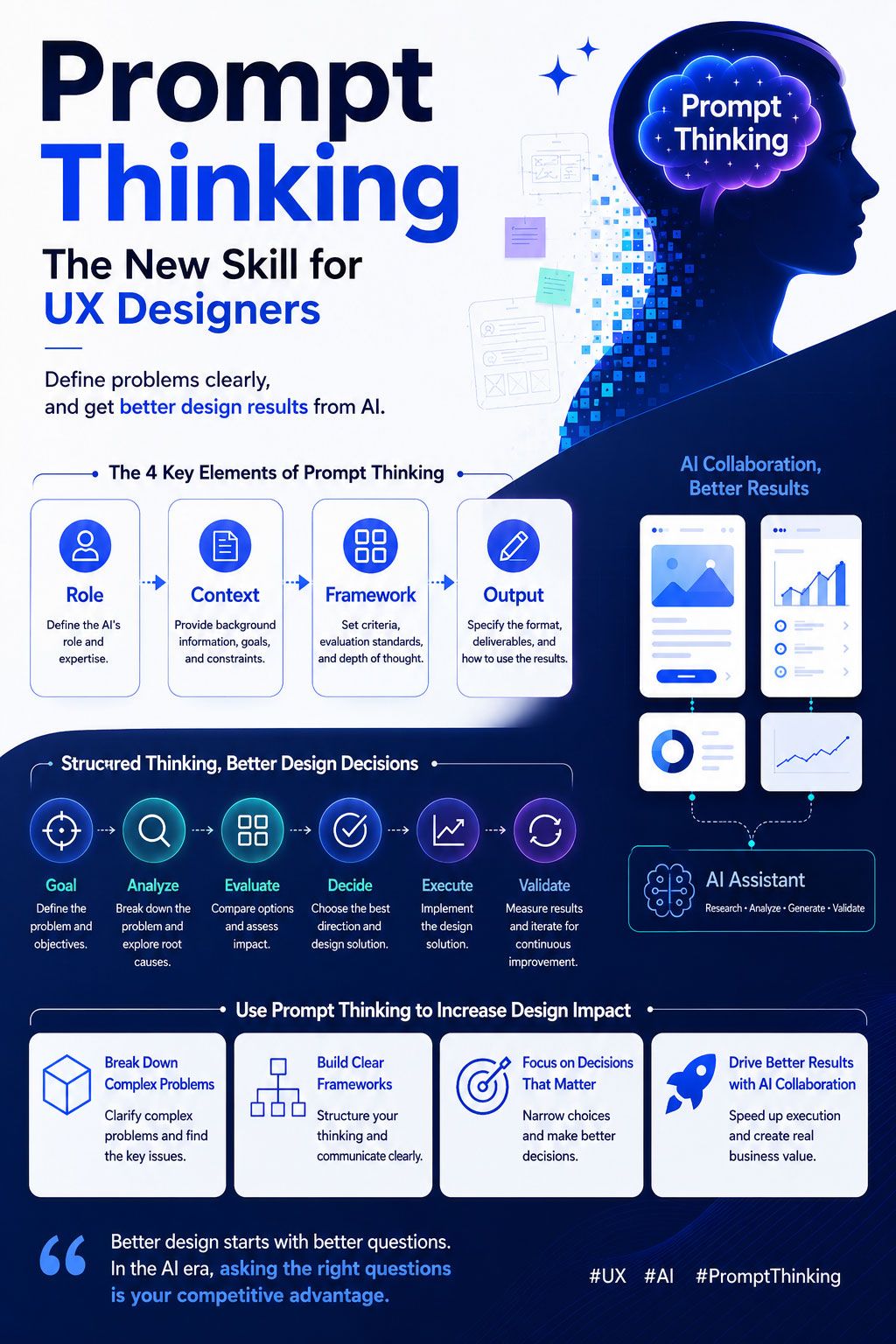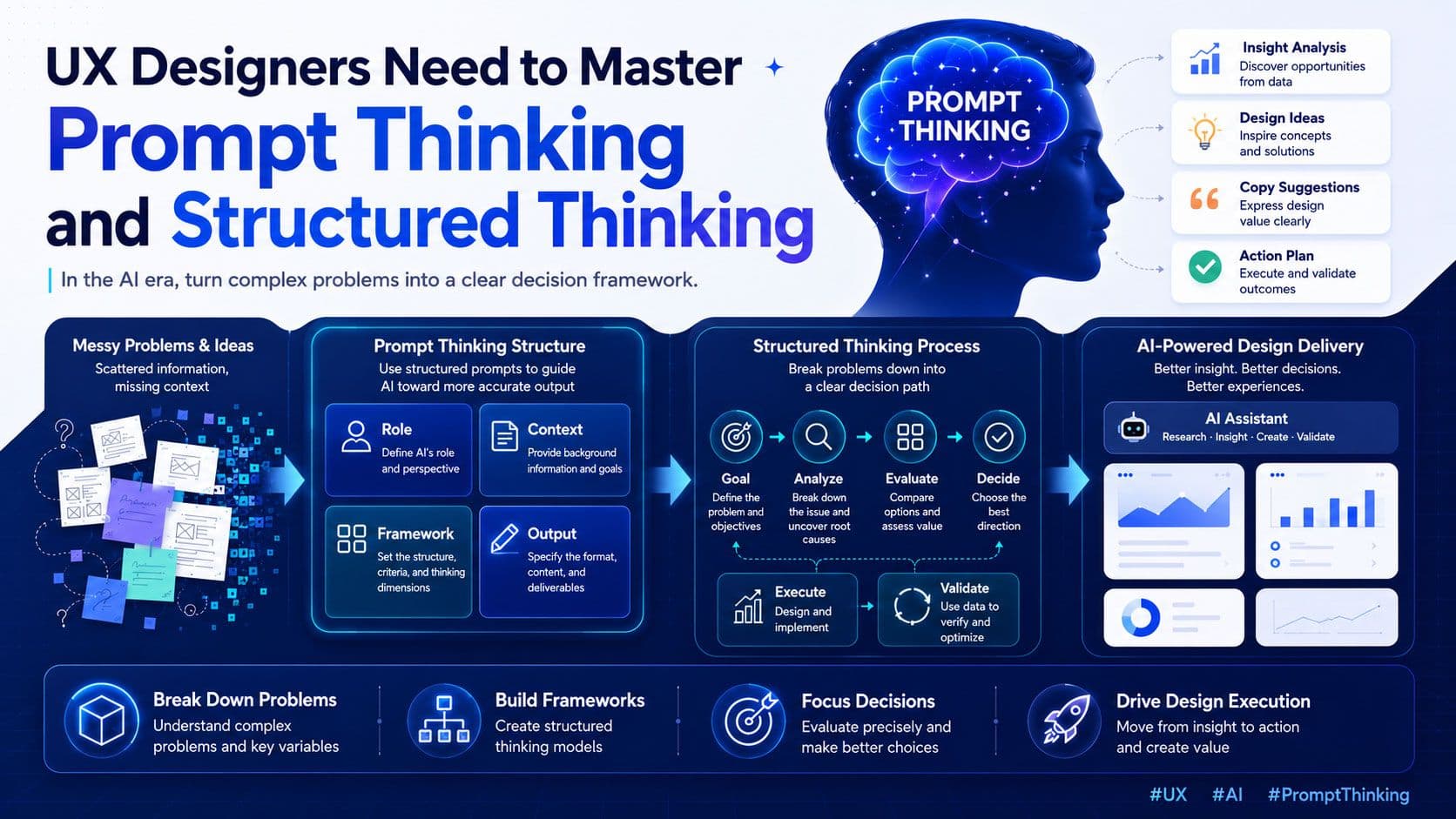
In the AI era, the way UX Designers work is changing rapidly. In the past, designers mainly relied on user research, design experience, product understanding, and visual execution skills to solve problems. Today, AI can already help us organize interview content, analyze user feedback, generate UX copy, suggest design directions, and even create design checklists.
However, the real question is not whether UX Designers know how to use AI tools. The more important question is whether designers can clearly define problems, break down complex situations, and guide AI in a structured way to produce valuable results.
This ability is known as Prompt Thinking and structured thinking.
For UX Designers, Prompt Thinking is not just about writing prompts, nor is it simply about asking AI questions. It is a working method that transforms UX expertise, analytical frameworks, design judgment, and output requirements into instructions that AI can understand and execute. When designers develop this ability, AI is no longer just a tool. It becomes a supporting partner for design thinking, problem analysis, and product decision-making.
1. Prompt Thinking Is More Than Asking AI Questions
Many people use AI by directly typing a simple question, such as:
What UX problems does this page have?
This type of question may produce some responses, but the results are usually superficial, such as “the button is not prominent enough,” “there is too much information,” or “the flow can be simplified.” These suggestions are not necessarily wrong, but they may not be specific enough, and they may not directly translate into effective design decisions.
For UX Designers, a more valuable approach is to place the problem within a clear analytical framework.
For example:
You are a senior UX Design Reviewer. Please analyze the UX problems of this product page based on usability, information hierarchy, user flow, CTA clarity, content readability, accessibility, and business goals. Please classify the issues by severity level: High / Medium / Low, and provide improvement suggestions.
This kind of prompt is not just “asking AI.” It puts the UX Designer’s professional thinking process into an AI workflow.
The core of Prompt Thinking is not about writing beautiful sentences. It is about clearly telling AI:
- What role it should take
- What background it should analyze from
- What criteria it should use for judgment
- What output format it should follow
- How the result should be transformed into actionable suggestions
This is exactly the new capability UX Designers need to master in the AI era.
2. Why Do UX Designers Need Structured Thinking?
UX work often deals with ambiguous problems. In many cases, product problems are not caused by a single factor. They are shaped by user needs, content presentation, process design, technical limitations, business goals, and team decisions.
For example, when the CTA click-through rate of a page is low, the problem is not necessarily just that “the button is not prominent enough.”
There may be many underlying reasons:
- Users do not understand the value of the feature
- The page information hierarchy is unclear
- The CTA copy is not specific enough
- The preceding content does not build enough motivation
- The flow is too long and causes users to lose patience
- There are too many distracting elements on the page
- Users may not be ready to take the next step
- The business goal may not align with the user’s current need
If designers only interpret the problem from a visual perspective, they may easily propose surface-level improvements. But with structured thinking, designers can break the problem down into different layers and identify improvement directions that are closer to the root cause.
Structured thinking helps UX Designers move beyond “I feel this is not easy to use” and ask deeper questions:
Why is it not easy to use?
Which type of users are affected?
Which user task is being blocked?
Which product metric is affected?
Which issues should be prioritized?
How should the improvement be validated?
This way of thinking makes design recommendations clearer, more persuasive, and easier to communicate with Product Managers, Developers, and Business teams.
3. Structured Thinking Is the Foundation of Prompt Thinking
In AI collaboration, the quality of the input directly affects the quality of the output. If designers do not clearly define the problem, AI can easily produce answers that are generic, vague, or disconnected from the actual product context.
For example:
Help me improve this UX.
This prompt is too broad. AI does not know the product background, the target users, the business goal, or what type of output the designer expects.
In contrast, if designers provide structured input:
This is a member registration flow. The goal is to increase registration completion rate. The main users are first-time app users. Current data shows that many users drop off on the personal information form page. Please analyze the possible problems based on user flow, form usability, CTA clarity, content readability, and trust-building. Then provide quick wins and long-term improvements.
AI’s response will become more specific and easier to apply to real design work.
Therefore, Prompt Thinking is not simply about “knowing how to write prompts.” It is about transforming the UX Designer’s structured thinking ability into a workflow that AI can follow.
It can be understood this way:
Structured thinking is the underlying capability. Prompt Thinking is the way designers express that capability when collaborating with AI.
Without structured thinking, prompts become random questions. With structured thinking, prompts can become repeatable, improvable, and scalable design working methods.
4. A Prompt Thinking Framework for UX Designers
When using AI, UX Designers can use a simple framework to build better prompts:
Role: Define the AI’s Role
First, tell AI what role it should take.
For example:
You are a senior UX Design Reviewer.
Or:
You are a Product UX Consultant specializing in mobile app conversion.
Role setting helps AI respond from a perspective that is closer to the task.
Context: Provide Background Information
Provide the product, user, and problem background.
For example:
This is an event registration page. The goal is to increase registration completion rate. The main users are app members who are interested in promotional offers. The current problem is that page views are high, but clicks on the registration button are low.
The clearer the context, the more relevant AI’s response will be.
Criteria: Set the Evaluation Standards
Tell AI what criteria it should use to evaluate the problem.
For example:
- User Goal
- Business Goal
- User Flow
- Information Hierarchy
- CTA Clarity
- Content Readability
- Accessibility
- Task Completion Efficiency
This step turns the UX Designer’s professional judgment into a clear evaluation framework.
Output: Define the Output Format
Finally, specify how AI should structure its response.
For example:
Please provide the analysis in the following format:
- UX Summary
- Key Problems
- Severity Level: High / Medium / Low
- Design Suggestions
- Suggested Copywriting
- Quick Win
- Long-term Improvement
A fixed output format makes AI responses clearer and easier for teams to read, compare, and reuse.
5. How Prompt Thinking Can Be Applied in UX Work
Prompt Thinking can be applied across many daily UX tasks.
UX Research
AI can help organize interview notes, summarize user pain points, classify user needs, and identify design opportunities.
For example:
Based on the following user interview notes, please summarize the key pain points, user needs, emotional concerns, and design opportunities. Please present the output in a table format.
This can help designers complete initial synthesis faster, but final insights still require designer judgment and validation.
UX Review
AI can support initial design reviews.
For example:
Please analyze the UX problems of this page based on usability, information hierarchy, CTA clarity, accessibility, and business goals. Provide actionable improvement suggestions.
This type of prompt is useful for design walkthroughs, prototype reviews, or preparation before internal team discussions.
UI Copywriting
AI can help generate different versions of UX wording, such as CTAs, empty states, error messages, and onboarding copy.
For example:
Please provide five versions of UX wording for this empty state. The tone should be clear, friendly, concise, and should encourage the user to take the next action.
This speeds up copy exploration, but designers still need to choose based on brand voice, user context, and product goals.
Product Insight
AI can also help transform data into UX hypotheses.
For example:
Based on the following data, please analyze possible user behavior issues and propose three UX improvement hypotheses. Each hypothesis should include the reason, impact, and validation method.
This is especially useful for helping UX Designers connect data, product thinking, and design decisions.
6. Structured Thinking Makes UX Recommendations More Persuasive
The role of a UX Designer is not only to propose design solutions, but also to explain why a solution is worth doing.
If a designer simply says:
I think this page should be simplified.
The suggestion may be seen as a personal opinion.
But if it is framed this way:
The main problem with the current page is not visual complexity, but unclear information hierarchy. When users enter the page, they need to understand the campaign mechanism, reward details, participation method, and terms and conditions at the same time. This weakens the main CTA. I suggest reorganizing the information priority by placing “how to participate” and “take action now” earlier in the page, reducing the user’s decision-making effort.
This explanation is clearer and more persuasive for the team.
A structured UX recommendation should usually include:
- What the problem is
- Where the problem appears
- Which user task is affected
- How it affects the product goal
- How the experience can be improved
- How the improvement can be validated
When designers can communicate in this way, UX is no longer just interface design. It becomes part of product decision-making.
7. Prompt Thinking Does Not Replace UX Designers. It Amplifies Their Ability.
AI can generate many suggestions, but not all suggestions are suitable for the actual product context. UX Designers still need to take responsibility for the most important part: judgment.
For example:
- Which problems truly affect users’ ability to complete tasks?
- Which improvements can increase conversion?
- Which suggestions align with the brand and product direction?
- Which solutions are technically feasible?
- Which issues are only visual polish, and which are flow or strategy problems?
- Which AI outputs can be used directly, and which need to be reorganized?
The value of Prompt Thinking is not to let AI replace designers’ thinking. It is to help designers guide AI more effectively and turn AI into a supporting tool for analysis, organization, and creation.
Designers with strong UX judgment will understand how to use AI better, because they know what to ask, how to ask, how to evaluate the answer, and how to transform the answer into design decisions.
8. From Prompt Thinking to Design AI Workflow
When a prompt has been used and refined multiple times, it can gradually become a repeatable Design AI Workflow.
For example, a UX Review Workflow can look like this:
Input page background
↓
Input target users and business goals
↓
AI analyzes problems based on UX evaluation criteria
↓
AI classifies issues by severity
↓
AI provides improvement suggestions
↓
AI generates UX wording
↓
Designer makes the final judgment and adjustments
This is the foundation for moving from a single prompt toward a Design AI Agent.
In other words:
Prompt Thinking is the starting point. Workflow is the method. Design AI Agent is the advanced application.
When a design team can organize common UX analysis methods, design review criteria, and output formats into prompt frameworks, they can build an AI-assisted design process.
9. The Value for Design Teams
Prompt Thinking and structured thinking are not only useful for individual designers. They also create value for the whole design team.
Improving Design Analysis Consistency
Different designers can use the same UX Review Prompt, reducing inconsistencies in review standards.
Speeding Up Early Exploration
AI can quickly organize initial directions, allowing designers to move faster into judgment and decision-making.
Supporting Junior Designer Growth
Junior Designers can learn UX analysis frameworks through structured prompts. They can better understand that design evaluation is not only about visuals, but also about user tasks, flows, content, and business goals.
Building a Team Knowledge Base
Common prompts can be accumulated into an AI Design Playbook, becoming a shared design method and working standard for the team.
Improving Cross-functional Communication
AI can help translate design observations into language that Product Managers, Developers, and Business teams can understand more easily, making UX suggestions easier to discuss and execute.
10. How Can UX Designers Start?
A simple way to begin is to create your own UX Review Prompt Template.
For example:
You are a senior UX Designer.

Please analyze the UX problems of this product page based on the following information and provide improvement suggestions.

Page / Feature:
Target Users:
Business Goal:
User Task:
Current Problem:
Relevant Data:

Please provide the output in the following format:

1. UX Summary
2. Key Problems
3. Severity Level: High / Medium / Low
4. Design Suggestions
5. Suggested Copywriting
6. Quick Win
7. Long-term Improvement

Please consider:
- Usability
- Information hierarchy
- User flow
- CTA clarity
- Content readability
- Accessibility
- Business goals
- Task completion efficiency
This template can first be used for a single page or feature. Later, it can be expanded into research summaries, user journeys, personas, A/B testing hypotheses, design QA checklists, and other use cases.
In the long run, these prompts should not remain as personal notes only. They can gradually become part of the team’s AI Design Playbook.