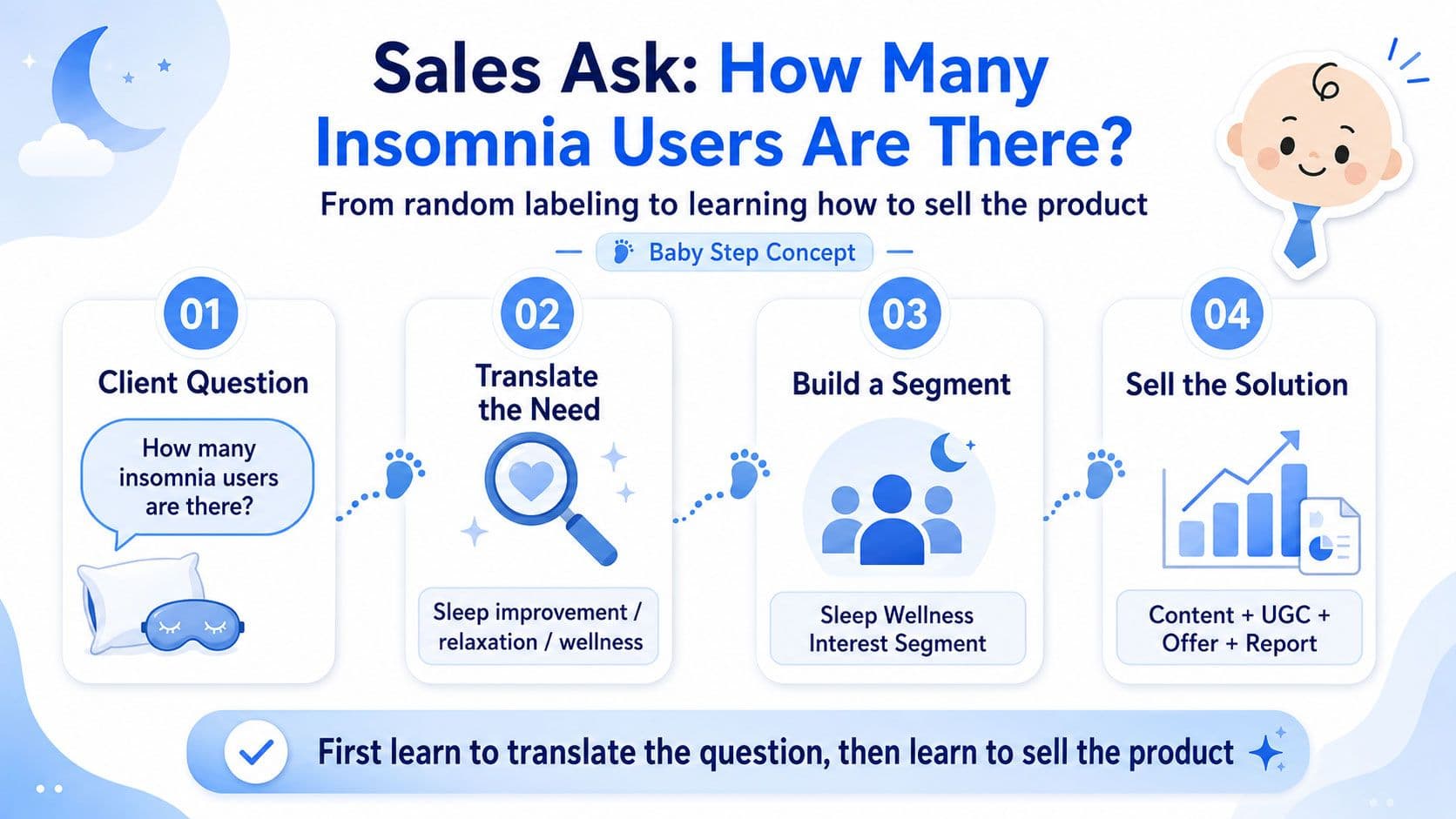
In media apps, UGC platforms, or content-driven products, Sales teams often ask very specific audience segmentation questions.
For example:
“How many insomnia users are there?”
“How many users have grey hair?”
“How many users have eczema?”
“How many mothers have two children and live in the New Territories?”
“How many high-income users also like travelling?”
From a Sales perspective, these questions are understandable. Clients usually want to reach a very precise target audience, and Sales also want to respond quickly: “We have this type of user and can help you target them.”
The problem is that these audience questions are often too direct, too identity-based, too sensitive, and sometimes not even supported by data.
Therefore, the real issue is not simply saying that Sales are asking the wrong questions. The real challenge is helping Sales learn how to translate these questions into a media product solution that can be supported by the product, validated by data, and understood by the client.
Sales Do Not Necessarily Lack Data Understanding; They May Not Know How to Turn the Question into a Product
When Sales ask:
“How many insomnia users are there?”
On the surface, this looks like an audience size question.
But in reality, there may be several real business needs behind this question:
- The client wants to sell mattresses, pillows, or bedding products.
- The client wants to promote aromatherapy, essential oils, massage, or spa services.
- The client wants to reach people who care about stress management and relaxation.
- The client wants to run a content campaign related to sleep quality.
- The client wants to know whether the platform has a wellness / healthy lifestyle audience.
So when Sales ask about “insomnia users,” they may not actually need a medical condition segment.
What they really need is an audience solution that helps the client understand, reach, and convert relevant users.
In other words, Sales should not directly sell:
“Insomnia users”
Instead, they should learn to sell:
“Sleep Wellness Interest Segment”
This is the core of an audience segmentation product.
Why Should We Avoid Selling “Insomnia Users”?
The term “insomnia users” sounds precise, but it has several problems.
First, insomnia is a health condition. It should not be casually inferred or sold by a platform.
Second, just because a user has viewed sleep-related content does not mean they have insomnia.
Third, the platform may not have directly collected this type of information.
Fourth, even if there are related behavioral signals, they should be expressed as “interest” or “intent,” rather than directly defining users as having a specific problem.
Fifth, this type of label is difficult to explain clearly to clients in terms of data source, and it may not support campaign reporting effectively.
Therefore, directly saying “we have this many insomnia users” is not ideal.
A better approach is to redefine the audience.
Turning “Insomnia Users” into a “Sleep Wellness Interest Segment”
A better name for this segmentation product would be:
Sleep Wellness Interest Segment
This segment does not mean that users “suffer from insomnia.”
It means:
This group of users has shown interest in sleep quality, relaxation, stress management, bedtime routines, bedding, aromatherapy, massage, or wellness-related content through content views, searches, clicks, saves, interactions, or offer actions.
The benefit of this definition is that it is not based on identity judgment. It is based on observable behavior.
For example:
- Viewed articles related to sleep quality
- Searched for bedtime relaxation methods
- Clicked on pillow, mattress, aromatherapy, massage, or wellness offers
- Saved content related to sleep improvement, stress relief, meditation, or healthy living
- Interacted with UGC related to relaxation, healthy habits, or mind-body balance
- Continued to follow wellness, healthy lifestyle, or home living content
These signals are more observable, measurable, reachable, and easier for Sales to package as a product than the label “insomnia users.”
What Sales Need to Sell Is Not a Label, but Commercial Intent
When many Sales teams talk about segmentation, they jump directly from the client brief to a user label.
For example:
The client sells hair coloring products, so Sales ask how many users have grey hair.
The client sells skincare products, so Sales ask how many users have sensitive skin.
The client sells mattresses, so Sales ask how many users have insomnia.
But a more mature Sales approach should be:
What kind of need does the client want to reach?
What behavioral signals can represent this need?
How can we package these signals into an audience product that is targetable, trackable, and reportable?
So what Sales need to learn is not memorizing a long list of segment names. They need to learn how to perform a layer of business translation.
From:
How many insomnia users are there?
Translate it into:
The client wants to reach people who are interested in sleep improvement, relaxation, healthy living, or related products.
Then translate it further into:
We can build a Sleep Wellness Interest Segment and activate it through content, UGC, offers, and campaign placements to drive reach and conversion.
This is the product story that Sales can actually sell.
A Sellable Audience Segment Should Pass Three Tests
If Sales want to sell a segmentation product, they can first use three questions to check whether the segment is valid.
First: Is It Observable?
Is this segment supported by data?
For example, do we have the following signals?
- Content view
- Search keyword
- Offer click
- Save / bookmark
- Like / comment / share
- UGC interaction
- Coupon claim
- Redemption
- Follow topic
- Repeat visit
If the audience only exists in the client’s imagination, but the platform has no observable behavior to support it, it should not be packaged as an audience product.
For example, “insomnia users” may not be directly observable.
But “users who recently viewed sleep improvement content, clicked on bedding offers, and saved healthy living articles” are more observable.
Second: Is It Large Enough?
Some segments sound very precise, but they may be too narrow in practice.
For example:
Female users who live in the New Territories, viewed aromatherapy articles in the past 7 days, clicked on mattress offers, saved bedtime routine content, and interacted with wellness UGC.
This setup may sound accurate, but the audience size may be too small, resulting in poor campaign delivery.
For Sales, a good segment should not only be “accurate,” but also large enough to support media delivery.
Therefore, a segmentation product needs to balance precision and scale.
Third: Does It Have Commercial Action Value?
A segment should not only be interesting. It should also connect to commercial actions.
For example, the “Sleep Wellness Interest Segment” can be mapped to the following client types and product packages:
| Client Type | Sellable Direction |
|---|---|
| Mattress / pillow brands | Sleep quality improvement campaign |
| Aromatherapy / essential oil brands | Bedtime relaxation ritual content |
| Spa / massage services | Stress relief and relaxation experience |
| Wellness apps | Meditation, breathing exercises, and bedtime routines |
| Home living brands | Comfortable sleep environment |
| Healthy lifestyle brands | Healthy lifestyle content package |
| UGC campaign sponsors | Users sharing bedtime habits, relaxation methods, or healthy living experiences |
If a segment can connect to content, advertising, UGC, offers, conversion, and reporting, then it has product value.
How Can Sales Respond to Clients?
When a client asks:
“How many insomnia users do you have?”
Sales should not directly say:
“Yes, we can target insomnia users.”
They also should not simply say:
“No, we cannot do that.”
A better response would be:
We do not directly define or label users by health conditions such as “insomnia.” However, we can build a more suitable campaign targeting segment called the “Sleep Wellness Interest Segment.” This segment is based on users’ actual browsing, search, click, save, and interaction behaviors around sleep quality, relaxation, stress management, bedtime routines, bedding, aromatherapy, massage, or wellness content. Therefore, it is more verifiable, trackable, and suitable for advertising delivery and campaign reporting.
This response has three benefits.
First, it does not directly infer users’ health conditions.
Second, it still responds to the client’s need to reach a relevant audience.
Third, it turns a sensitive question into a sellable product solution.
Sales Enablement: Give Sales a Translation Formula
To help Sales truly learn how to sell an audience segmentation product, we should not only give them a list of segment names.
More importantly, we should give them a translation formula.
The formula can be:
Client Question
→ Business Need
→ Observable Signals
→ Productized Segment
→ Commercial Package
→ KPI / Reporting
Using “insomnia users” as an example:
Client Question
How many insomnia users are there?
Business Need
The client wants to reach people who are interested in sleep improvement, relaxation, healthy living, or related products.
Observable Signals
Content views, search behavior, offer clicks, saves, UGC interactions, and coupon claims.
Productized Segment
Sleep Wellness Interest Segment.
Commercial Package
Sponsored content, UGC campaign, offer recommendation, wellness topic sponsorship, and native ad placement.
KPI / Reporting
Impressions, content engagement, offer clicks, saves, coupon claims, redemptions, topic follows, and conversion rate.
In this way, Sales do not just ask whether we have this type of user. They begin to understand how to package audience demand into a product.
How Can an Audience Segmentation Product Be Packaged?
To make it easier for Sales to sell, segmentation products can be packaged into different levels.
Package 1: Interest Segment Package
Suitable for small to mid-sized campaigns.
For example:
Sleep Wellness Interest Segment
Beauty and Skincare Interest Segment
Family Activity Interest Segment
Travel Deals Interest Segment
Food Discovery Interest Segment
What Sales are selling here is a reachable interest-based audience.
Package 2: Content Signal Package
Suitable for content marketing / native advertising.
For example:
We can build a highly relevant content targeting solution based on users’ recent content views, searches, saves, and interactions.
This is not simply selling banners. It is selling content relevance.
Package 3: UGC Engagement Package
Suitable for brands that want to run participatory campaigns.
For example:
Invite users to share bedtime relaxation methods, healthy living habits, comfortable home environments, or product usage experiences.
The value of this package is not only exposure. It is user participation and authentic content.
Package 4: Offer Conversion Package
Suitable for clients with coupon, merchant offer, or ecommerce objectives.
For example:
Users interested in sleep wellness content can be shown related mattress, pillow, aromatherapy, massage, or wellness offers.
This package can connect to offer clicks, coupon claims, and redemptions.
Package 5: Insight Report Package
Suitable for large brands or long-term partnership clients.
For example:
After the campaign, provide an audience insight report analyzing which content attracted the most users, which offers received the most clicks, and which keywords or topics generated the highest engagement.
This helps brands understand market interest and also helps Sales upsell the next campaign.
From a Data Science Perspective: Segmentation Is Not Guessing People, but Finding Patterns
In Data Science and Machine Learning, clustering is a common unsupervised learning method. It does not start by manually defining every type of user. Instead, it finds natural groups from large amounts of unlabeled data based on similarity.
Applied to a media app or UGC platform, we should not begin by asking:
Do we have insomnia users?
Instead, we should ask:
Within sleep, relaxation, and healthy living-related content behaviors, is there a group of users showing similar interests and intent?
For example, through content views, searches, clicks, saves, UGC interactions, and offer clicks, we may identify different types of audience groups:
- General wellness audience
- Sleep Wellness Interest Segment
- Relaxation and stress relief audience
- Product comparison researchers
- Highly engaged wellness users
- Content browsers who have not yet converted
- Offer-sensitive coupon users
These segments are more specific, safer, and easier to turn into actionable product and sales packages than “insomnia users.”
The Value of UGC Products: Turning Content into Sellable Intent
UGC is valuable, but it should not only be seen as “user posts.”
The real value of UGC is that it reflects what users care about, what problems they may be facing, what solutions they are looking for, and what actions they may be ready to take.
For example:
- A user shares, “I have not been sleeping well recently and tried a certain aromatherapy product.”
- A user saves an article about “bedtime relaxation methods.”
- A user clicks on a “pillow offer.”
- A user searches for “how to improve sleep quality.”
- A user comments on how to relax when feeling stressed.
- A user joins a “bedtime routine” submission campaign.
Individually, each behavior may not mean “insomnia.”
But when these behaviors accumulate, they can form a more commercially meaningful interest segment.
This is the value of UGC + content behavior + offer interaction.
UGC is not only content supply. It can also become part of audience understanding, intent signals, and commercial solutions.
The Key to Helping Sales Learn to Sell the Product
To help Sales learn how to sell audience segmentation products, Product / Data / UX teams can prepare several things.
1. Segment Dictionary
Build a dictionary of sellable segments.
Avoid using overly sensitive or unverifiable names such as:
- Insomnia users
- Grey-haired users
- Eczema users
- High-income users
Use safer and more explainable names instead, such as:
- Sleep Wellness Interest Segment
- Hair Care / Hair Coloring Intent Segment
- Sensitive Skin Care Interest Segment
- Premium Lifestyle Interest Segment
2. Segment Evidence
Each segment should come with a clear explanation of its data sources.
For example:
This segment is built from content views, searches, saves, offer clicks, and UGC interactions.
Sales need to know that the segment is not invented out of thin air.
3. Sales Talk Track
Provide Sales with a client-facing talk track.
For example:
We do not directly define users by sensitive identity labels, but we can build safer and more trackable interest segments through observable behavior.
This helps Sales appear more professional in front of clients.
4. Product Package
Do not only give Sales an audience name.
Give them a package:
- Where it can be delivered
- What content it can work with
- What UGC mechanism can be added
- What offers it can connect to
- What report can be delivered
Only then will Sales know how to quote and sell it.
5. Case Scenario
Each segment should have application scenarios.
For example, the “Sleep Wellness Interest Segment” can have three scenarios:
First, a mattress brand wants to run a sleep quality campaign.
Second, an aromatherapy brand wants to promote a bedtime relaxation ritual.
Third, a wellness app wants to reach users interested in stress relief and healthy living.
This helps Sales turn a segment into a story that clients can understand.
Good Sales Do Not Sell Data; They Sell Solutions
In many cases, clients do not want to buy an audience list.
What clients really want to buy is:
- More accurate reach
- A more relevant content environment
- Better user participation
- Stronger brand trust
- Behaviors closer to conversion
- Clearer campaign reporting
So Sales should not only say:
We have this group of users.
They should say:
We can build a reachable, measurable, and continuously optimizable audience solution based on users’ content interests and behavioral signals, helping your brand reach people who are genuinely interested in sleep wellness and relaxation lifestyles.
This is what it means to sell the product.
Conclusion: Segmentation Is Business Translation, Not Identity Judgment
“How many insomnia users are there?” looks like a Sales question on the surface.
But behind it are product, data, privacy, UX, and business strategy issues.
If we only answer “yes” or “no,” segmentation becomes a set of rough user labels.
But if we translate the question properly, it can become a sellable media product:
From “insomnia users”
to “Sleep Wellness Interest Segment”
then to a commercial solution involving content, UGC, offers, and conversion.
Helping Sales learn to sell segmentation products is not about giving them more strange labels.
It is about helping them understand:
We are not selling users’ identity labels.
We are selling the interests, intent, and actionable commercial value that users show through behavior.
Segmentation is not random labeling.
Segmentation is the process of turning user behavior into commercial intent that is understandable, reachable, measurable, and continuously optimizable.