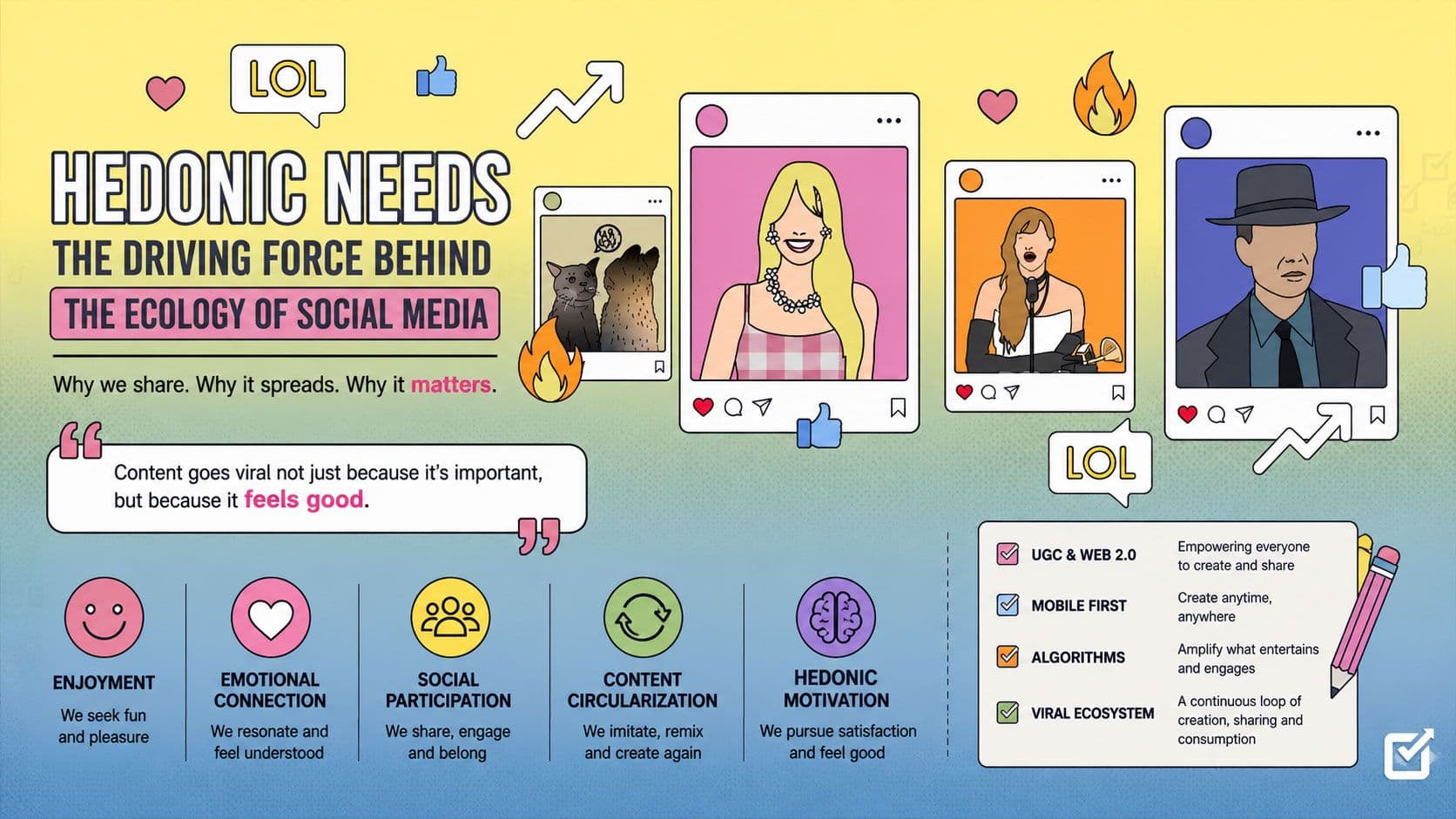
Back in 2016, short-video platforms and AI-generated content were not yet as widespread as they are today. However, meme culture, viral content, and user-generated content had already begun to rapidly influence the entire online ecosystem. At the time, I paid particular attention to the fact that the most shareable content was often not the most informative content, but the content that could most effectively trigger emotion, entertainment, and resonance.
Therefore, I attempted to analyze humorous content, Internet memes, imitation culture, and viral communication in social media from the perspective of Hedonic Needs. I also proposed the concept of “Social Content Circularization” to explore how content spreads in a circular way through imitation, adaptation, and recreation.
Looking back at this essay today, many of the observations are closely related to today’s TikTok culture, reaction culture, AI meme generation, short-video ecosystems, and even algorithm-driven engagement. In many ways, social media has always been driven by people’s pursuit of entertainment, emotion, and recognition.
We open:
TikTok
Instagram
Facebook
Threads
YouTube Shorts
Very often, we are not doing so for “communication.”
Instead, we are looking to:
Pass time
Seek entertainment
Watch memes
Watch short videos
Watch other people’s reactions
Find emotional resonance
Social media has gradually evolved from an information platform into an ecosystem driven by emotion and entertainment.
Behind this shift lies an important psychological factor:
Hedonic Needs
What Are Hedonic Needs?
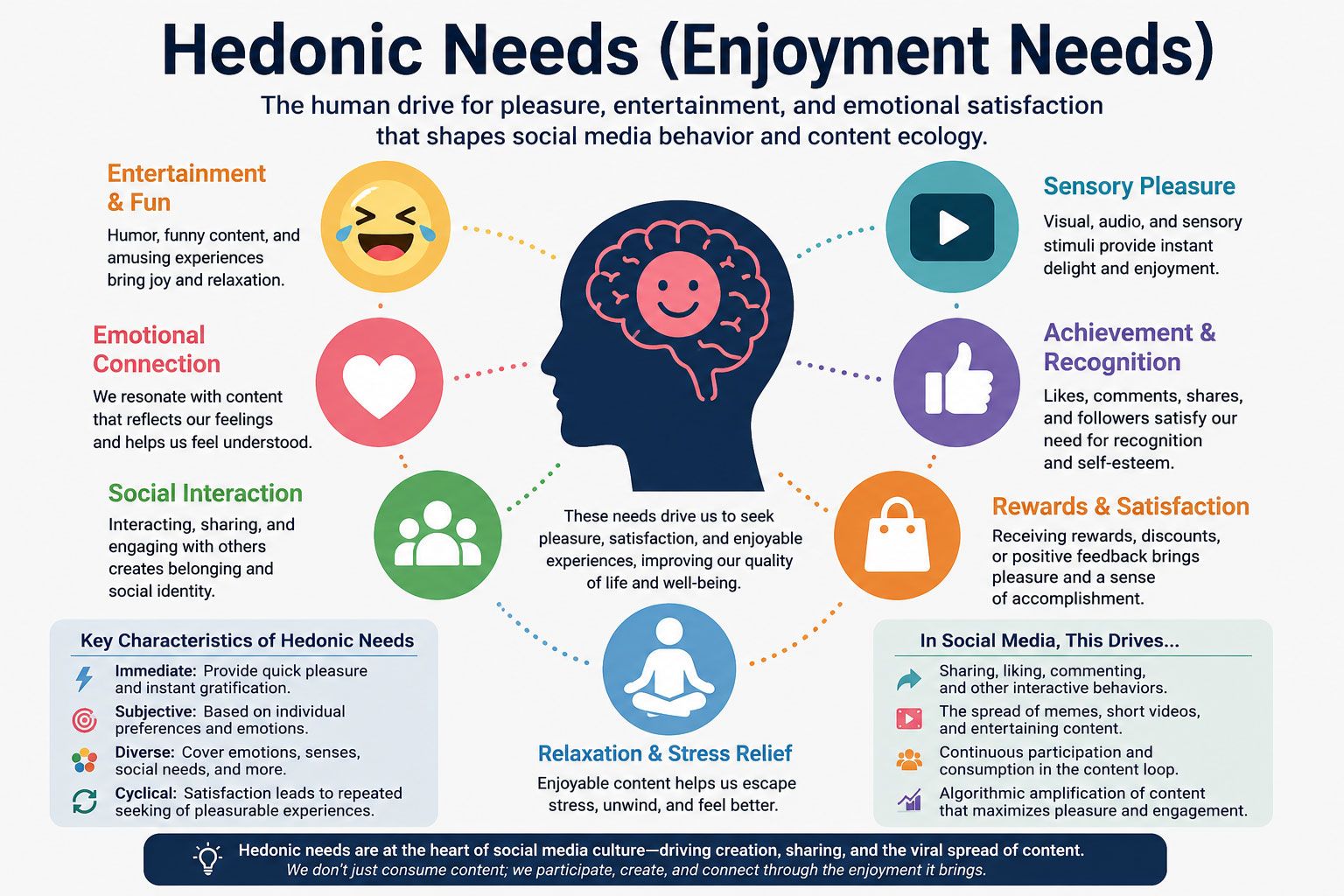
Hedonic Needs can be understood as:
The human desire for pleasure, entertainment, enjoyment, and emotional satisfaction.
In Hedonism, pleasure is regarded as one of the important goals of human life. In the context of modern psychology and media studies, this concept can also be extended to emotional satisfaction, self-expression, recognition, and social belonging.
In social media, these needs often appear in everyday behavior:
People watch funny videos because they want to relax.
People share memes because the content creates resonance.
People remix trends because participation itself feels enjoyable.
People comment, like, and repost because these actions create emotional and social connection.
In other words, social media content is not only about information. It is also about how content makes people feel.
Why Is Funny Content Especially Easy to Go Viral?
Hedonic Motivation refers to the psychological need to pursue pleasure, entertainment, and emotional satisfaction. Classical Hedonism suggests that happiness is an important human goal, while modern psychology extends this idea further into emotional and psychological fulfilment.
Within the social media ecosystem, people do not browse content only to obtain information. They actively share, imitate, and recreate content because of humor, resonance, and entertainment value. Internet memes, viral videos, and reaction content are typical examples of Hedonic Content.
The concept of “Social Content Circularization” proposed in the research describes how content continues to spread through imitation, adaptation, and remixing. People share content not only because of the information itself, but because the content creates emotional resonance, self-identification, and social participation.
(Adapted from: Jacky Wan. (2016). Hedonic Needs and the Ecology of Social Media.)
On social media, content that is most likely to be widely shared usually has several characteristics:
Easy to understand
Emotionally direct
Able to quickly create resonance
Easy to imitate
Easy to recreate
Funny content fits almost all of these conditions.
Examples include:
Meme images
Reaction GIFs
Funny short videos
Parody
Template memes
AI-generated edits
These forms of content do not require complex understanding, yet they can instantly bring entertainment and emotional release.
As a result, they are easier than long-form articles to be:
Shared
Reposted
Remixed
Imitated
This is also why meme culture can spread so quickly.
Social Content Circularization
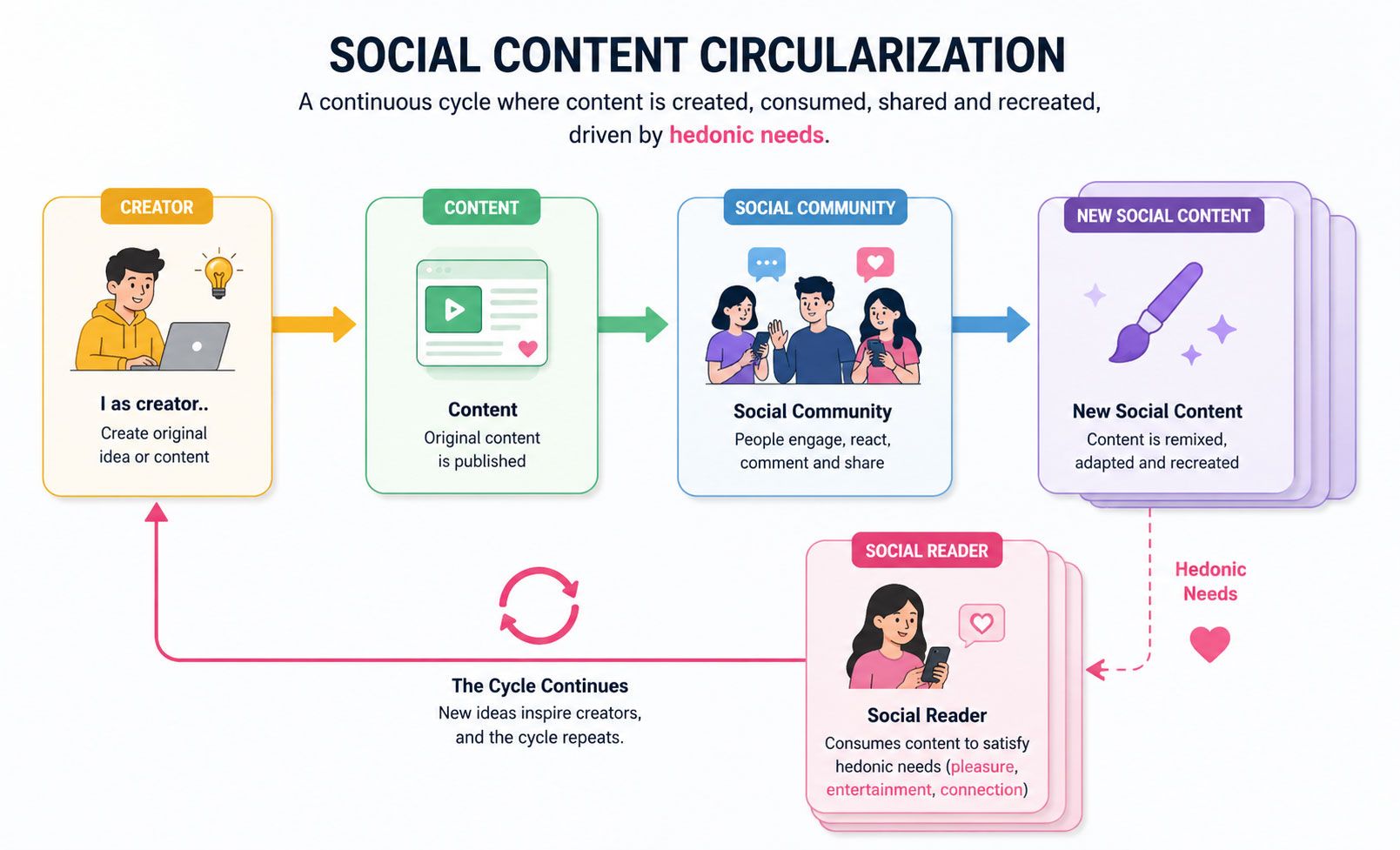
One of the core concepts in the original essay is Social Content Circularization. This concept describes how content forms a continuous cycle through creation, sharing, imitation, remixing, and recreation.
The cycle can be understood as follows:
The creator publishes content.
The content enters the social community.
Social readers watch, react, and share.
Some users imitate or remix the content.
New social content is created.
The cycle starts again.
This process is especially visible in meme culture. Memes are rarely fixed. They change as users reuse them, add new captions, apply them to different contexts, or transform them into new formats. The value of a meme does not only come from the original content, but also from the collective participation formed around it.
Therefore, social media content is not transmitted in a linear way. It is circular, participatory, and constantly evolving.
Why Does Meme Culture Spread So Quickly?
Internet memes are powerful because they combine humor, simplicity, identity, and imitation. A meme can be an image, a phrase, a video, a sound, a behavior, or even a format that can be repeatedly adapted and reproduced.
People share memes not only because they are funny, but because memes help people express identity and emotion. A meme can represent:
“This is how I feel.”
“This is my situation.”
“This is something we have all experienced.”
“This belongs to our culture.”
This emotional and social function makes memes highly shareable. When people see themselves in the content, they are more likely to forward it, repost it, or even create their own version.
This is why meme culture is closely connected to Hedonic Motivation. People participate because it brings entertainment, self-expression, and social reward.
The Role of Social Media Algorithms
In today’s social media environment, algorithms further amplify Hedonic Content. Platforms usually prioritize content that can generate engagement, such as watch time, likes, comments, shares, saves, and replays.
Hedonic Content naturally fits this system because it easily creates quick emotional reactions. When content is funny, surprising, relatable, or visually attractive, people are more likely to stop scrolling, tag friends, comment, or watch it again.
As a result, entertainment-driven content receives more exposure, and social media platforms gradually encourage more similar content to appear.
This creates a feedback loop:
People enjoy entertaining content.
They interact with it.
The platform recommends more similar content.
More creators produce similar content.
The overall culture becomes more entertainment-driven.
Algorithms Are Amplifying This Phenomenon
Today’s platform algorithms strongly favor “high-emotion content.”
This is because platforms mainly value:
Watch time
Engagement rate
Share rate
Comment volume
Replay rate
Hedonic Content is very effective at generating these metrics.
Compared with rational or informational content, entertainment content is more likely to make people:
Stop and watch
Interact immediately
React emotionally
Share with friends
Therefore, platforms continue to recommend this type of content.
Over time, the entire social media ecosystem begins to move toward an:
Entertainment-driven ecosystem.
The AI Era Is Accelerating the Growth of Hedonic Content
The rise of AI has further lowered the barrier to content creation.
In the past, creating memes may have required:
Photoshop
Video editing skills
Design skills
Now, all people may need is:
A prompt
A photo
An AI tool
to quickly generate:
Memes
Parody videos
AI voice content
Reaction images
Remix content
This means that the speed and scale of Hedonic Content production are growing faster than ever before.
AI has made this content cycle even faster. In the past, creating memes, edited images, parody videos, or remix content required design ability, editing tools, and production time. Today, AI tools can generate images, captions, videos, voices, and visual effects within seconds.
This significantly lowers the creative barrier. More people can participate in content production, and the same idea can quickly appear in many different versions.
Therefore, AI accelerates Social Content Circularization, allowing Hedonic Content to be created, modified, and redistributed at greater speed and scale.
From Information Platform to Emotional Platform
Social media was once mainly understood as a tool for communication and information sharing. Today, it increasingly resembles an emotional platform.
People use social media to reduce boredom, release stress, seek humor, gain a sense of belonging, express identity, and build emotional connections with others. Content spreads not only because it is useful, but because it creates a certain feeling.
This changes the ecology of social media. The most successful content is not necessarily the most informative or the deepest content. Very often, it is the content that is easiest to feel, share, imitate, and recreate.
Social Media Is Becoming an Emotional Platform
Today, many people open social media not to obtain important information.
Instead, they are looking to:
Seek emotional stimulation
Gain entertainment
Reduce stress
Escape reality
Find recognition
Social media has gradually become:
A digital space dominated by emotion and hedonic needs.
Meme culture, viral content, reaction culture, and short-video ecosystems are all products of this ecology.
Conclusion
Hedonic Needs are not a new concept.
However, in today’s social media era, they have become one of the most important forces driving content circulation.
People do not simply consume content.
They also:
Imitate content
Adapt content
Share content
Use content to express themselves
This cycle driven by entertainment, emotion, and resonance is redefining the entire ecology of social media.
Perhaps the most powerful content today is not necessarily the content with the greatest depth.
It is the content that makes people:
Feel something.
Reference
Jacky Wan. (2016).
Hedonic Needs and the Ecology of Social Media — A research study exploring meme culture, viral content, and hedonic motivation in user-generated social media ecosystems.
Master’s Research Paper, City University of Hong Kong.